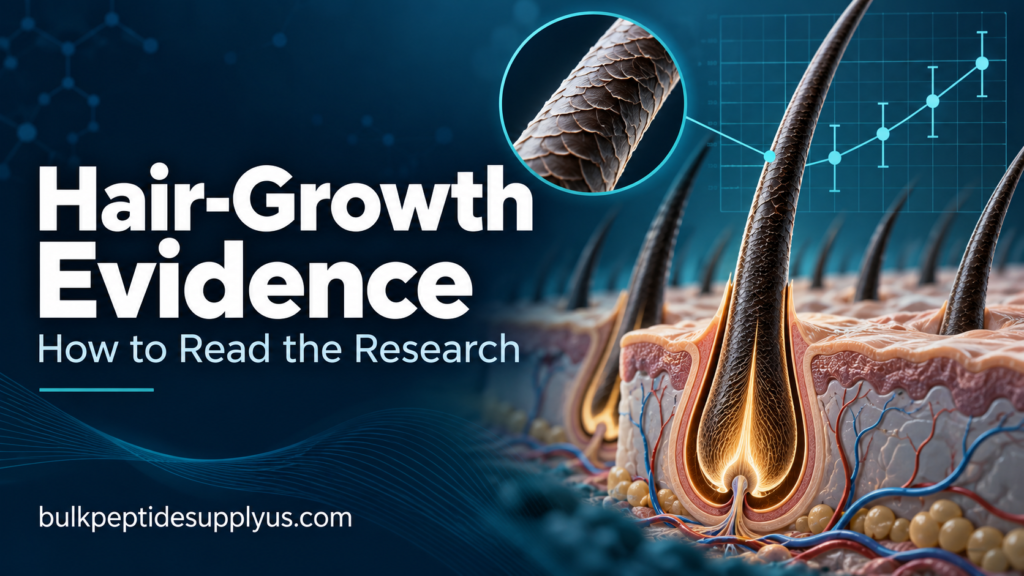
Hair-growth peptide claims can feel persuasive when they arrive with an impressive photograph. Hair counts, shaft thickness, shedding, and perceived coverage describe different outcomes. Understanding what a study measured helps readers separate evidence about a defined formulation from a general promise about hair growth. This guide develops that reading approach without suggesting a treatment or a research-material routine.
Identify the question behind the claim
Hair thinning and shedding have different causes and patterns. A broad search phrase does not establish which process is involved. Research may examine a particular condition, a cosmetic appearance measure, or follicle biology in a laboratory model. Those settings should remain visible in any summary.
Start by naming the population and outcome. A finding about one type of hair change should not become a claim about everyone noticing less coverage. Age, concurrent treatments, underlying conditions, and the pattern of hair loss can affect applicability. Tested on people is therefore not enough detail to determine whether a study answers a particular question.
For personal symptoms, diagnosis belongs with a qualified professional. Educational reading can help someone understand terminology and prepare questions, but it cannot make the individual assessment that a clinical conversation requires.
Hair measurements do not all mean regrowth
A study might count hairs within a defined area, measure shaft diameter, assess shedding, or collect satisfaction ratings. Each method captures something different. Better apparent coverage does not necessarily mean that more hairs are growing.
Ask whether investigators evaluated the same scalp area at each visit and described their counting method. Consistent measurement is important because a selected region may not represent the person’s overall appearance. A numerical outcome should retain its location, method, and time frame when it is summarized.
Participant experience also matters, but satisfaction is not an objective hair-growth count. A formulation could alter texture or styling and make hair look fuller without demonstrating a change in follicle growth. Both observations can be discussed accurately if the language identifies what each actually shows.
Treat photographs as measurements
Lighting, angle, camera distance, hair length, styling, and wetness can influence a before-and-after image. Two authentic photographs can create a misleading comparison if those conditions differ. Authenticity alone does not isolate the reason for the change.
Imagine an initial photograph taken with wet hair under bright overhead light and a later photograph showing longer, dry hair in softer light. The apparent improvement may have several explanations.
A stronger record uses standardized conditions, a defined assessment area, a suitable comparison, and clear timing. It also explains how displayed participants were selected. The most favorable image from a study is not necessarily representative of the full distribution of outcomes.
Give the observation period its proper role
Hair-related outcomes develop over time. A short study might capture cosmetic changes or ordinary fluctuation rather than a durable difference in growth. A longer study still needs appropriate comparisons and consistent measurement.
Look for the planned time points and whether the report includes them all. Selecting only the most favorable visit can change the impression readers receive. Ask whether persistence after the intervention ended was assessed or whether the findings concern continued use only.
The same timing discipline applies to concurrent treatment. Changes in grooming or medical care may occur alongside the studied intervention. Without a clear account of these factors, the contribution of one ingredient remains uncertain. The summary should acknowledge that uncertainty instead of filling the gap with a confident explanation.
The finished formulation matters
A topical formula includes a vehicle, other ingredients, packaging, concentration, and stability characteristics. A study of that complete formula addresses the formula as tested. It does not automatically establish the same result for an isolated peptide or a different mixture.
Ingredient research can explain why a product was developed, but contains a studied ingredient is not equivalent to this formulation demonstrated this outcome. A multi-ingredient study may not isolate one component’s contribution unless the comparison was designed to do so.
Routes of exposure must remain separate too. Evidence about topical cosmetic research cannot be transferred to an injectable material simply because a name is shared. Research-grade labeling does not establish that a raw material is suitable for scalp application or human administration.
Documentation has a different job
A certificate of analysis may describe tests on an identified sample. It can help readers understand analytical documentation, but it cannot prove regrowth. The presence of a polished report does not repair missing controls in a hair study.
Match the sample description, batch identifier, method, date, and reported result. A component report cannot establish every property of a finished blend. Purity is also different from active content, biological activity, and microbiological quality.
An honest conclusion may be that a claim cannot be assessed from the available information. That is more useful than treating missing evidence as proof either of benefit or of wrongdoing. Precise limits protect the meaning of both research findings and laboratory records.
Read the whole evidence record
Keep a note of the measured outcome, comparison, duration, formulation, and main limitation. Read numerical results alongside photographs and participant reports. Look for adverse events and missing follow-up, rather than relying on a selected success story.
Explore the full hair-growth evidence guide for more detail. Visit the Bulk Peptide Supply US home page for site information or contact us about this educational resource. Research materials are not personal hair treatments, and this article offers no instructions for their use.